Author Archives: lelwd

Outdoor Watering Restrictions

Outdoor Watering Restrictions in Effect

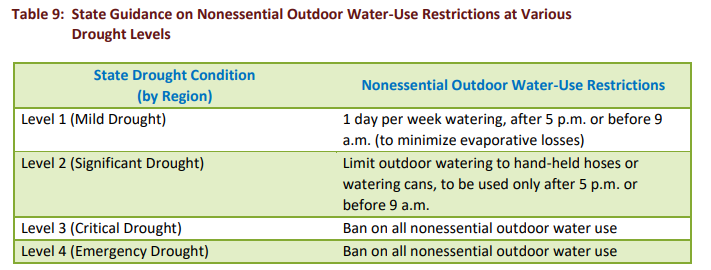
Per MassDEP

Please Conserve Water

Littleton is experiencing a Level 2 Significant Drought. All nonessential outdoor water uses are banned, except that watering ornamentals and flower gardens with drip irrigation, hand-held hose or watering cans are permitted.

What outdoor watering is prohibited?

All non-essential outdoor water uses, which include:

    • irrigation of lawns via sprinklers or automatic irrigation systems;
    • washing of vehicles, except in a commercial car wash or as necessary for operator safety; and
    • washing of exterior building surfaces, parking lots, driveways or sidewalks, except as necessary to apply surface treatments such as paint, preservatives, stucco, pavement or cement.
    • Filling swimming pools

What outdoor watering is allowed?

    • Watering of vegetable gardens
    • Watering ornamentals and flower gardens with drip irrigation, hand-held hose or watering cans.

What are the penalties for violating the ban?

Any person violating this regulation shall be liable to the Littleton Water Department as follows:

  • 1st Violation: Written warning
  • 2nd Violation: $50.00 fine
  • 3rd Violation: $200.00 fine
  • 4th Violation: $400.00 fine and reduction in water availability to allow for basic water use needs.

Each day of violation shall constitute a separate offense.

What Causes Water Restrictions?

Water restrictions result from a lack of precipitation as measured by drought conditions and low stream flows.

First, the restrictions depend on the severity of the drought in the region, as declared by the state’s Drought Management Task Force. The restrictions remain in place until the Task Force determines the drought conditions have dissipated.

Stream Flows

Second, the restrictions on nonessential outdoor water use in Littleton can also be triggered by flows in the Concord River below River Meadow Brook at Lowell falls, as measured by the U.S. Geological Survey gage.

Two (2) days per week, before 9 a.m. and after 5 p.m., when:

  • The gage falls below 427 cubic feet per second for three (3) consecutive days, between May 1 and June 30, or
  • The gage falls below 156 cfps for three (3) consecutive days between July 1 and September 30.

One (1) day per week, before 9 a.m. and after 5 p.m., when the gage falls below 71 cfps for three (3) consecutive days.

The restrictions remain in place until streamflow at the gage meets or exceeds the trigger streamflow for seven (7) consecutive days.

Private Well Owners

While private well owners are not required to comply with the water restrictions, we ask that they do their part to conserve water, as it all comes from the same aquifer.

WHERE CAN I GET MORE INFORMATION?

Residents and consumers are encouraged to call LWD with any questions at 978-540-2222.

Drought Monitoring

Rain Barrel Program

Rain Barrel Program

Rain Barrels are available for purchase at the discounted price of $89.00.

Littleton Water Customers are offered an additional $20 savings with the coupon LWD26

How to Purchase Your Rain Barrel:

Go to The Great American Rain Barrel , Select “Massachusetts” and “Littleton”, then follow the instructions on their website.

Deadline for Ordering:

Date: Sunday, May 24th

Time: Midnight

Coupon Code: LWD26

Days Left!

Pickup Instructions:

Date: Saturday, June 6th

Time: 9am -11am

Location: LELWD, 39 Ayer Road, Littleton MA

About The Great American Rain Barrel Company:

The Great American Rain Barrel is a local food importing company that has been repurposing shipping drums into Rain Barrels since 1988. The Great American Rain Barrel Co. has been an approved vendor by the MASS DEP since 2010.

If customers have product and installation questions that they cannot find on the website, or would like to order over the phone, please email [email protected] with your phone number and question and they will follow up. 

LELWD Survey

Littleton Electric Light and Water Department’s survey will be open from April 27th through May 22nd. 

Littleton Electric Light and Water Department has contracted GreatBlue Research, a third-party data collection agency, to assist with our survey.

The candid responses and opinions are completely confidential and will only be presented as part of the overall report.  The 1974 U.S. Privacy Act requires that GreatBlue maintain the anonymity of respondents to surveys the firm conducts.  No information, by law, will be released that might in any way, reveal the identity of a respondent. 

If you have any questions about the survey, please feel free to contact GreatBlue Research at [email protected] or by phone at 860.740.4000. 

Pagacik Scholarship

The Denise M. Pagacik Memorial Scholarship

The Denise M. Pagacik scholarship is an annual, merit based scholarship that focuses on rewarding ambitious individuals interested in the fields of engineering or environmental sciences.

This scholarship was created in memory of Denise M. Pagacik of Littleton, Massachusetts. Denise was a loving mother and wife who lived in Littleton for over 25 years. She was a selfless member of the community who was always there for others at any given moment.

The Denise M. Pagacik scholarship is funded by the Littleton Electric Light and Water Departments (LELWD). In establishing this scholarship, LELWD wishes to recognize the positive impact that Denise had on our community by assisting students to achieve their career goals; an objective which has the added benefit of bettering the community at large.

ELIGIBILITY

Applicants of the Denise M. Pagacik Scholarship must:

  • Be a graduating senior from Littleton High School or a Littleton High School Graduate completing freshman year of college.
  • Have maintained a grade point average of at least 3.0.
  • Must be pursuing a bachelor’s degree in the fields of Engineering or Environmental Science at an accredited undergraduate institution in the United States.

* It is strongly encouraged that the student successfully participated in the Littleton Electric Light and Water Department’s Dual Enrollment Program

AWARD

If selected as a recipient, the student will receive a one-time award of up to a $2,000 scholarship.

For LELWD to issue the payment, the recipient must contact the college you are attending and get a proof of enrollment. The proof of enrollment can be sent directly to LELWD. LELWD will then forward the scholarship award to the college.

APPLICATION PROCESS

To apply, complete the application below and submit a one page essay explaining the importance of community selflessness and how you would like to define your career.

DEADLINE

The deadline for submitting an application was March 31st, 2026.

SELECTION OF RECIPIENTS

The Littleton Electric Light and Water Department will evaluate all applicants. Applicants will be evaluated and selected using the following criteria:

  • Academic excellence and intellectual passion
  • Great distinction in leadership activities
  • Strength of vision for how your goals can be fulfilled
  • Commitment to community involvement
Dual Enrollment and Scholarship

Denise M. Pagacik Memorial Scholarship Application

Sewer Ribbon Cutting

New Littleton Common Sewer System Fully Operating

LITTLETON – The new Littleton Common Sewer System is fully operational after nearly two years of construction to install sewer mains and construct a water resource recovery   facility. The system has already sparked economic development in the town center and will improve groundwater quality by reducing reliance on septic systems.

The $45 million project started in the spring of 2023 and finished on schedule in the fall of 2025. The project was awarded $11 million in MassWorks grants and $2 million federal funds. The remaining cost will be paid by sewer users and not local tax revenues.

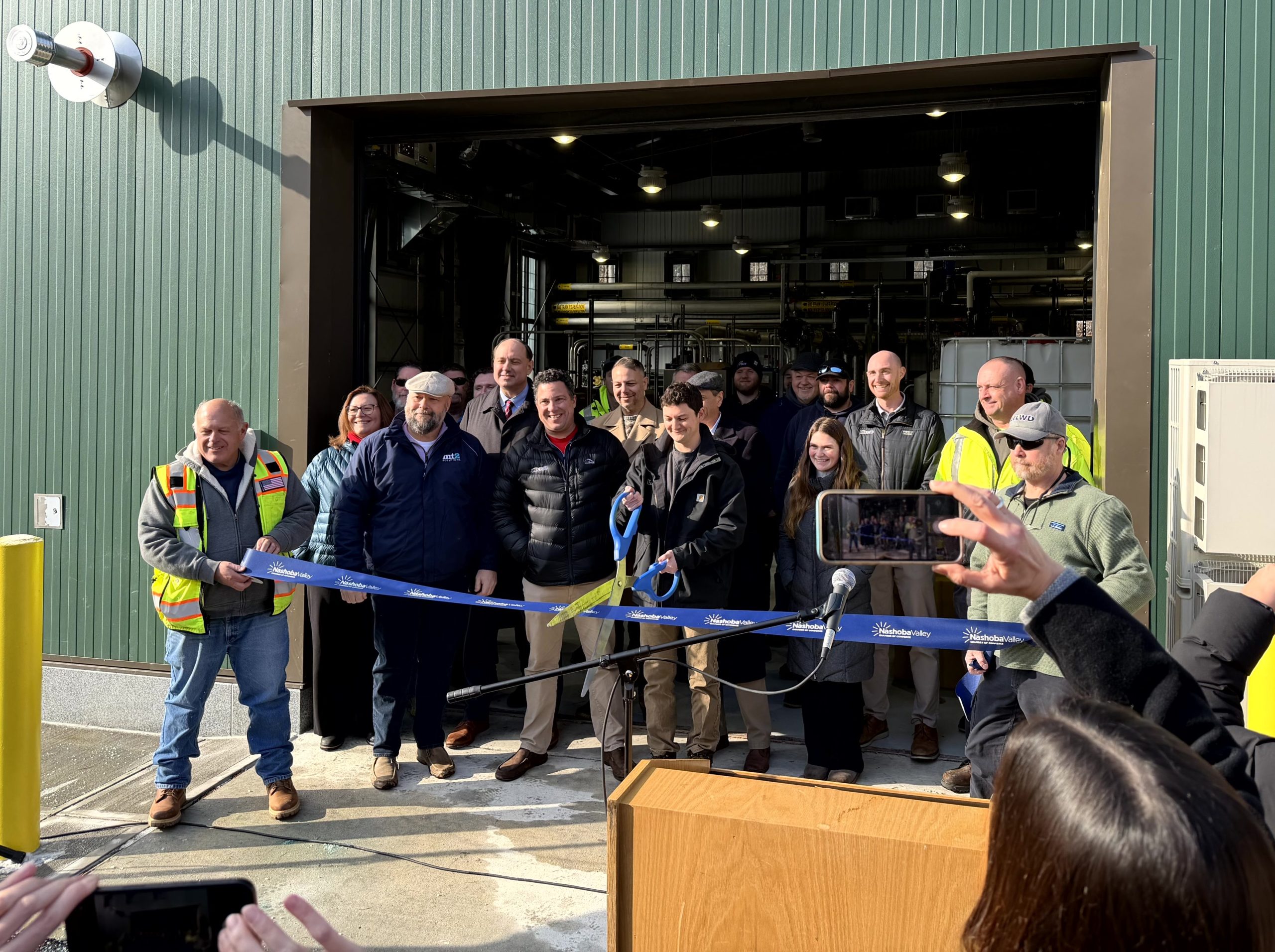
Local and state officials, the project contractors, and others gathered at the wastewater resource recovery facility on a cold January day for a ribbon-cutting ceremony.

“For many years, our town has dreamt of a sewer system to serve the Common, and today it is a reality because of the support of the people of Littleton and the leadership of the Board of Water Commissioners and the professional staff at the Littleton Water Department,” said Ivan Pagacik, Chairman of the Board of Water Commissioners. “Even before a shovel broke ground, the plans for the system were sparking development projects on King Street and Great Road, proving its potential for increasing economic activity.”

“This new sewer system will benefit economic development and the environment for generations to come. A project of this size and scope is made possible with assistance from many state, local, and private partners. We are grateful to the Board of Commissioners and all the town boards, committees and departments; the Littleton Town Meeting voters; state Rep. James Arciero and his legislative colleagues; and the Mass.

Department of Environmental Protection, MassDOT, and other state agencies and officials,” said Nick Lawler, P.E., General Manager of LELWD.


The sewer system is permitted by the MassDEP for up to 243,000 gallons per day. The Littleton Common Sewer District will serve 58 commercial-business properties, including several town buildings. The mixed-use development at 550 King Street will be the system’s largest user, followed by the Town of Littleton buildings.

About 50 residential properties are eligible to connect to the system. After a commissioning period in the fall, the sewer system and plant are operational and serving municipal buildings. Properties within the district are now able to connect to the system. The sewer betterment fee, required to connect to the system, is about $40,000 per Residential Equivalent Unit, a standard billing and measurement unit used to compare the impact of different properties to that of an average single-family home.

Even before the completion of construction, sewer planners have been considering future expansion. LELWD is in discussions with MassDEP about increasing the system’s permitted capacity. In addition, the potential exists to expand the district boundaries to serve other areas of Littleton.

The sewer collections system runs from the Westford town line south on King Street, and from the business area on Great Road west to the Common. From there, the system travels south on King Street to Shattuck Street and across lots to Russell Street. It meets the WRRF at 242 King Street, and after treatment, effluent travels to the discharge site adjacent to Littleton High School.

Sewer systems provide benefits to economic development and the environment. The Littleton Common sewer system is expected to spur the development of underutilized properties that have greater potential when connected to the system. This will increase local tax revenues, create new jobs and services, and add needed workforce housing. Sewer systems also improve groundwater quality by replacing septic systems. The Littleton Common area is within the Zone 2 Aquifer Protection Area surrounding the Beaver Brook drinking water wells.

###

LELWD Awarded $285K State Grant

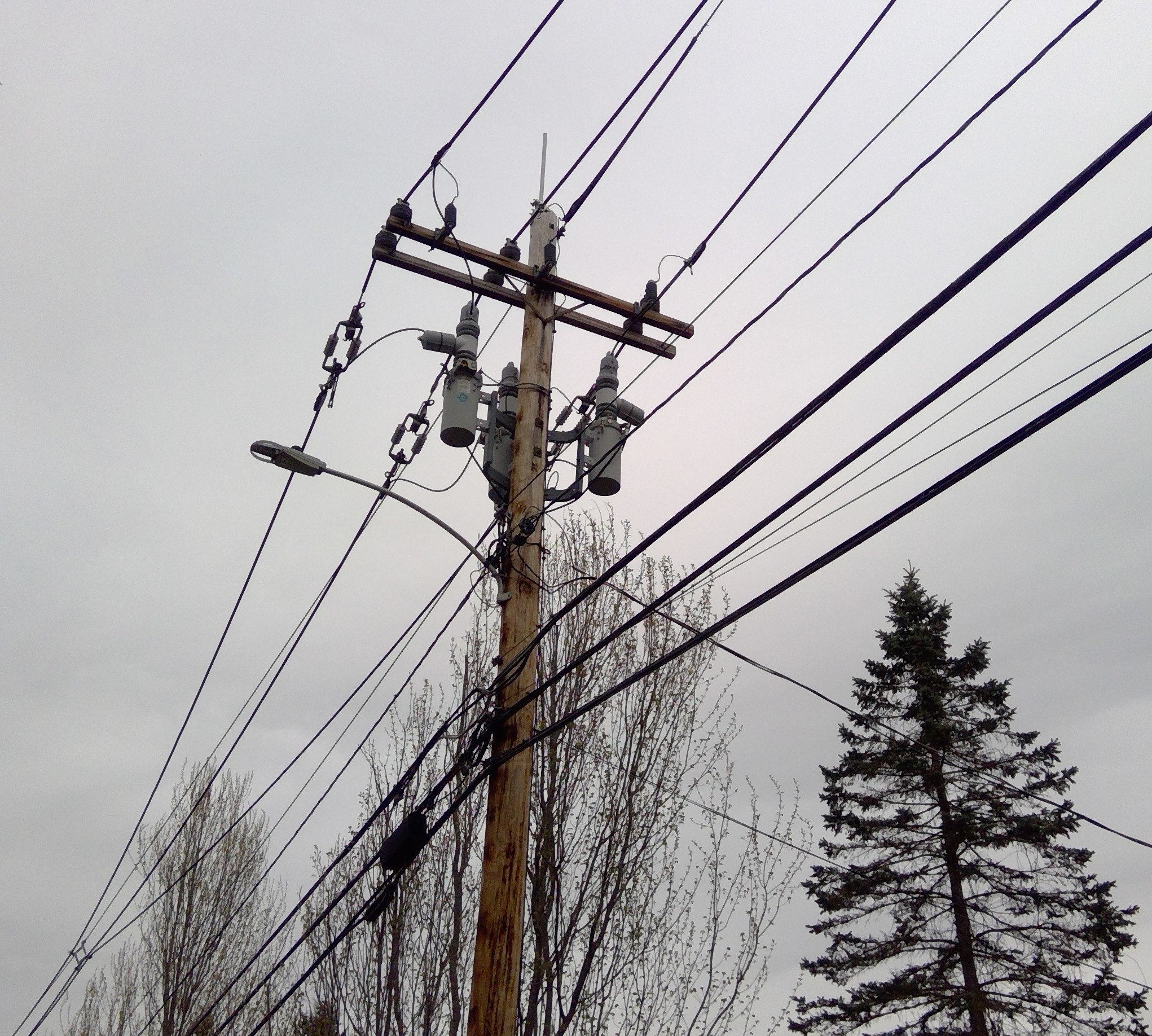
Recloser on a utility pole

LELWD Awarded $285K State Grant

LELWD has won a state grant to reduce the impact of power outages by upgrading equipment in the distribution system. The $285,522 grant was recently awarded by the Massachusetts Clean Energy Center’s (MassCEC) Grants for Enhancing Grid Resilience and Reliability Program.

LELWD will use the grant to install six aging reclosers in its distribution system in Littleton and Boxborough. Reclosers isolate damaged sections of power line, shutting off electricity to the fault, and rerouting electricity around the fault to customers. These switches, in conjunction with sensors and software, turn a potentially large outage into a small, quickly resolved one.

“By upgrading the LELWD infrastructure, technology enables us to automatically isolate an outage by rerouting electricity around the trouble spot. This reduces the number of customers who lose power and helps crews quickly identify and fix the problem. We are grateful to MassCEC for providing this award and recognizing the work LELWD does to keep the lights on for our customers,” said Nick Lawler, P.E., General Manager of LELWD.

MassCEC awarded more than $8 million to seven municipal electric utilities and UMass-Amherst for projects to  strengthen the electric grid, reduce costly outages, and better protect residents from the impacts of extreme weather.

LELWD’s customers lost electricity for a total of 30 minutes on average in 2024, compared to 149 minutes for consumers nationwide. The LELWD has been recognized for Excellence in Reliability for eight consecutive years by the American Public Power Association.

###

LELWD on ’60 Minutes’

LELWD Case Study Resulted in ’60 Minutes’ Story

Read the Case Study

As seen on “60 Minutes,” the Littleton Electric Light and Water Departments has publicized the case of foreign hackers targeting its computer systems. LELWD first made the announcement in March with the release of a case study to educate the utility industry and others on cybersecurity threats.

For more information, read LELWD’s public statement from March below and click here to read the case study. 

The LELWD issued the following statement on March 14, 2025:

LELWD Publicizes Case Study on Foreign Hackers Targeting U.S. Utilities

LITTLETON, MA – The Littleton Electric Light and Water Departments has participated in a case study with its cybersecurity provider that details the immediate steps taken to protect its computer networks after a 2023 intrusion by foreign hackers. There was no serious threat to public safety or customer data, and LELWD hopes publicizing the problem and solution helps utilities of all sizes act on the threats posed by foreign adversaries.

Here are key points to consider:

  • No customer-sensitive data was compromised.
  • In November 2023, the FBI alerted the LELWD that a Chinese cyberespionage group, Volt Typhoon, had access to its system. At that time, investigators told the LELWD that about 200 New England organizations were similarly affected.
  • The LELWD took immediate action and cooperated with the U.S. Cybersecurity and Infrastructure Security Agency (CISA) to install sensors to monitor the activity of the hackers. While in the system, it appeared the hackers accessed a file server that stores public records.
  • By December 2023, the federal government and the hackers were off the system. Last August, CISA returned to the LELWD to perform a two-week penetration test that showed the cybersecurity defenses working properly. The LELWD is a distribution company, and its systems do not have access to or control of the larger, critical electrical grid infrastructure. It appears the LELWD was targeted simply because its system used a firewall with a known security flaw. The then-managed service provider had not updated the firmware and as a result, was terminated.
  • The LELWD was already bolstering its cybersecurity to better monitor operational technology (OT) assets, security information technology and OT network traffic, and monitor communications between OT devices and systems. OT systems are used to control and manage physical equipment and processes.
  • The LELWD now contracts with managed served provider EvoLab Technology Solutions and uses a system monitoring platform from Dragos, Inc., a provider of OT cybersecurity technology for industrial and critical infrastructure. In addition, the LELWD’s network architecture was changed to render unusable any system information potentially obtained by the hackers.

“We were able to quickly isolate the threat in late 2023 before anything happened, and we accelerated our ongoing work to strengthen our cybersecurity. We worked with the U.S. Department of Homeland Security’s CISA, the FBI, the American Public Power Association, and our cybersecurity partners, EvoLab and Dragos, to protect our systems. We can now publicize this threat and solution to educate other small utilities. You would never think that you’d be targeted, but there is a real threat from foreign adversaries,” said Nick Lawler, General Manager of the LELWD.

The cybersecurity improvements were led by David Ketchen, Assistant General Manager, whose efforts were recognized by the state’s Executive Office of Technology Services & Security. Ketchen received the Cybersecurity & Risk Management award at the Massachusetts Excellence in Technology Awards in September 2024.

The LELWD was supported by the American Public Power Association, a national organization representing municipal electric utilities nationwide. Though its cybersecurity programs, the APPA has awarded more than $14 million to 32 utilities, funding 78 cybersecurity projects.

“The response to the LELWD breach was swift, according to Dragos. Investigators identified the attacker’s movements, including server message block traversal and remote desktop protocol lateral movement,” reported Infosecurity Magazine. “The compromised organization was able to contain the threat and reconfigure its network to prevent further exploitation. No customer-sensitive data was reportedly compromised.” ###

Customer Scam Alert! Click here for details

Please be aware of telephone scams.  LELWD will never seek immediate payment over the phone using a prepaid debit card or money order. LELWD does not contract with Eversource or another utility on service shut offs. If called about an instant payment or service disconnection, immediately hang up and call LELWD to verify your account status at 978-540-2222, Mon.-Thurs., 6:30 a.m. – 4:30 p.m.

Source Water Protection

Protecting Our Water Source

The Littleton Water Department is committed to delivering clean, reliable water. The LWD and the Town of Littleton integrate land-use planning, groundwater monitoring and environmental audits in a comprehensive aquifer and watershed protection program.

The Town’s Aquifer and Water Resource District zoning bylaw restricts the land uses permitted near drinking water wells. LWD’s environmental analysts regularly test 150 monitoring wells on 40 properties to confirm water quality.

Littleton’s drinking water is regularly tested for contaminants and found to be a higher quality than required by state drinking water standards. For more information, see the 2024 Annual Drinking Water Quality Report.

Littleton's Drinking Water Wells

LWD pumps water out of underground aquifers and into its distribution system at these locations:


  • The Whitcomb Avenue wells.
  • The Spectacle Pond well.
  •  The Beaver Brook wells.
  • The new Trumbull well on Taylor Street is under development.


What's an Aquifer?

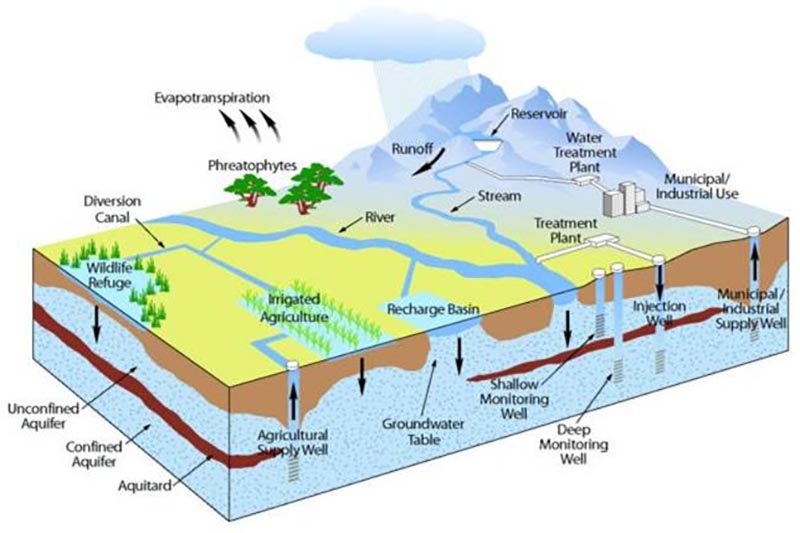
An aquifer is a layer of sediments or rocks under the surface that is capable of holding large amounts of water. Think of a jar filled with pebbles. Pour in water, and it fills the gaps between the rocks.

Rain fills the aquifers by seeping through soil and permeable surfaces, slowly entering the aquifer – a process known as groundwater recharge. Lakes, rivers and wetlands also contribute to recharge.

Groundwater moves not only down deeper into the earth, but it also flows across the soil layer. As drinking water wells pump water out of the aquifer, groundwater flows toward the wells to replenish the supply. This groundwater flow can take a long time to reach the wells.

Aquifer water quality is only as good as the groundwater recharge supplying it. Water can transport substances and chemicals it

encounters. While water does get somewhat “filtered” through natural processes on its journey to and through the aquifer, secondary treatment is necessary in LWD’s treatment plants.

Zone Defense: Protecting Sources

Prevention is the best way to keep groundwater free of contamination.

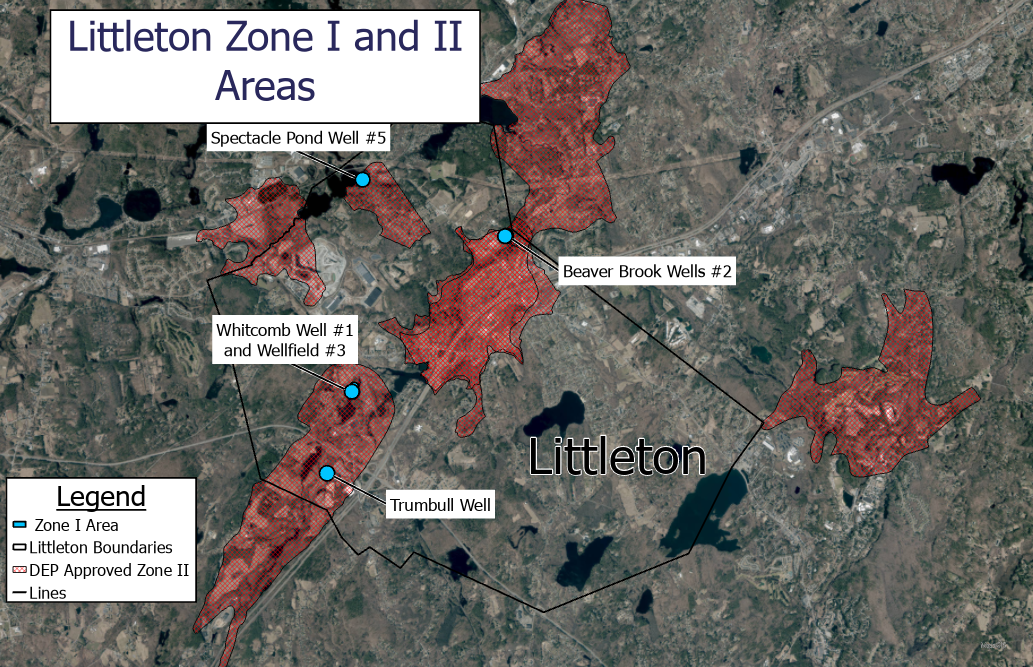
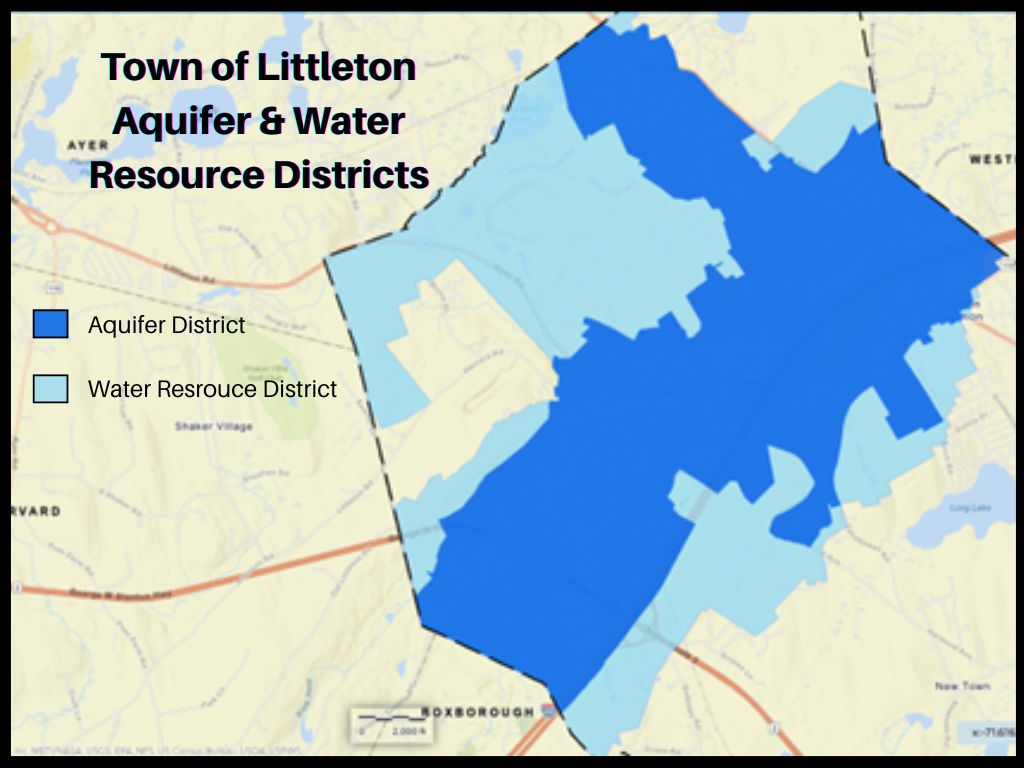
Littleton’s groundwater wells are protected by Zones I, II, and III. The zones surround the wells, with Zone I the most restrictive. Zone I is a defined distance from the water source, and Zones II and III are set by the area’s impact on the aquifer. (See the map for Zone I and II locations.)

Zone I: A 400-foot radius around the LWD groundwater wells. LWD owns the land and no trespassing is permitted.

Zone II: Not a fixed radius, Zone II is the area that will transmit groundwater to the wells when there is no precipitation recharge for three months. Littleton’s bylaws establish an Aquifer District to restrict allowable uses in order to protect groundwater. The Aquifer District encompasses the Zone II areas. (The Aquifer District is shown in dark blue on the nearby map.) The bylaw prohibits activities within the Aquifer District, including the storage of hazardous waste, road salt and treatments, petroleum products, chemicals and fertilizer. It also prohibits automobile sales, junkyards, landfills, truck terminals, and deep earth removal.

Zone III: It is areas outside of the Aquifer District that also contribute to aquifer recharge. Zone III is also called the Water Resource District (shown in light blue on the nearby map). Generally, a special permit is required to authorize certain activities in this zone. Approved developments in this zone are typically required to install water monitoring wells as a condition of the special permit.

Groundwater Monitoring Program

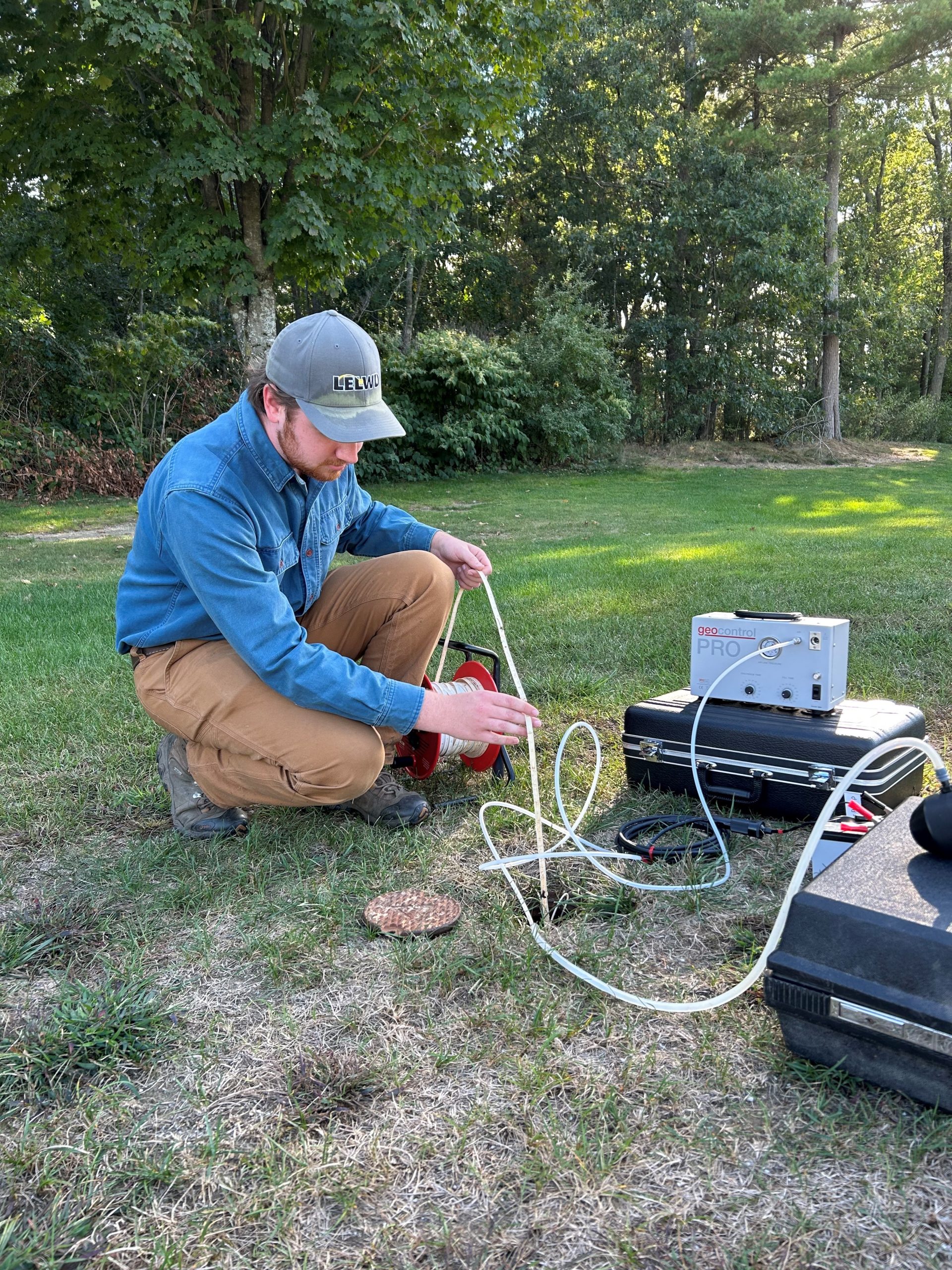
In Littleton, 144 groundwater-monitoring wells are located on over 40 properties. They are maintained and sampled by the water department to monitor for the presence of contaminants and to track pollution trends across the monitoring well sites.

Monitoring wells, as opposed to production wells, are used to extract samples for quality testing. They are a window into aquifer water quality.

LWD’s environmental staff annually samples the wells and sends it for testing at qualified laboratories. Typically, water is sampled for general chemistry parameters like pH, conductivity, temperature, turbidity, etc.

Samples may be analyzed for mineral content, nitrogen species, metals and heavy metals, and volatile organic compounds. Per state water quality standards, water samples may also be tested for specialty pollutants like per- and polyfluoroalkyl substances (PFAS), perchlorate, bacteriology, and more.

Environmental Audits

Water Department environmental personnel are authorized to conduct environmental audits of regulated facilities to ensure compliance with Littleton’s Aquifer and Water Resource Protection Bylaws and other state and federal regulations. These typically consist of a walk-through inspection to assess the environmental liability of products at the site, with recommendations offered for safe storage and handling procedures.

Additional Resources

Credit: State of Washington Department of Ecology

Paving Schedule

Paving & Planting Scheduled to Complete Sewer & Water Main Projects

The following paving related to LELWD projects is planned for the remainder of 2025.

Whitcomb Avenue

Paving is planned for the week of September 15. Work will take place in three phases with separate detours for each:

    1. Taylor St. to Sanderson Rd.
    2. Sanderson Rd. to Porter Rd.
    3. Porter Rd. to Route 2 Bridge
  • Expect detours between 7 a.m. and 4 p.m.
  • This will be a full-width paving.
  • Follow detour signs and use caution in this area. 

Meetinghouse Road

King Street
Common to Westford line

King Street
small area near I-495 bridge

Great Road
near Acton Toyota of Littleton

Paving is expected in October and November. This section will be updated when more information is available from the contractor.

Paving schedules are subject to change without advanced notice.

Milling grinds off the top layer of existing asphalt to prepare the surface for paving. Milled roads may not be immediately paved. Please proceed with caution.

The contractors are required to repair and seed damaged turf at the end of the project – typically after the final road paving. The project specifications call for any planting to occur between April 15 and June 1 or between August 15 and October 30.

For More Information On The Projects